
At Central CosMedic, Dr Danielle Waxman provides full body skin cancer checks, skin lesion assessment and biopsy, mole removal and skin tag removal for patients across Havelock North, Hastings, Napier and the wider Hawke’s Bay. Dr Waxman holds diplomas in both Dermoscopy and Skin Cancer Medicine, and offers radiofrequency skin lesion removal using the Ellman Surgitron, a quick way to remove harmless moles, skin tags and other lesions, often without stitches.
New Zealand has one of the highest rates of melanoma in the world, and skin cancers are generally easier to treat when they are found early. Whether you want a routine check, have noticed a spot that has changed, or would like a harmless mole or skin tag removed, this page explains what is involved.
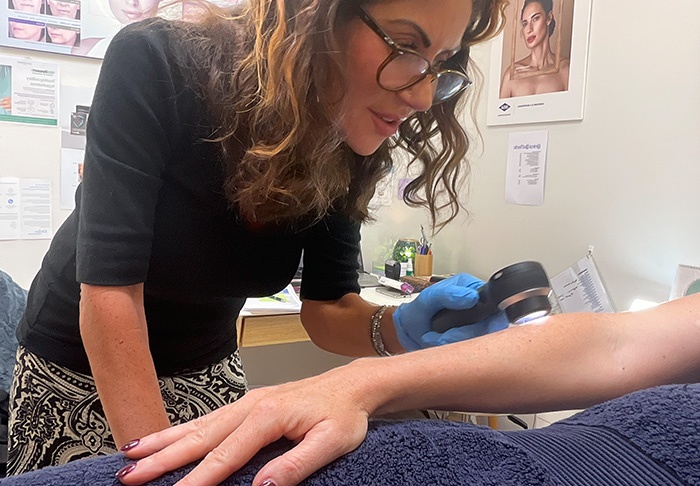
A full body skin check is a head-to-toe examination of your skin, looking for any spots that could be skin cancer or may become a problem in future. Dr Waxman uses a dermatoscope, a hand-held device that gives a magnified, high-resolution view of each spot with specialised lighting. This shows features beneath the surface of the skin that cannot be seen with the naked eye, helping to tell harmless spots apart from those that need a closer look.
Spots of interest can be photographed and stored securely in your patient record. This allows them to be compared at future checks, so any change over time can be picked up.
Anyone can have a skin check, but they are particularly worthwhile if you:
If you have noticed a spot that is changing, do not wait for a routine check. Book an appointment so it can be looked at promptly.
Some spots are harmless but can be bothersome, catch on clothing or jewellery, or simply be unwanted. Once Dr Waxman is satisfied a lesion is harmless, skin lesion removal can often be carried out using the Ellman Surgitron, which uses radiofrequency energy to remove the lesion without the need for stitches. If there is any uncertainty about a spot, it will be sent to the laboratory rather than removed cosmetically.
Lesions that can often be treated this way include:
The area is numbed with a local anaesthetic first. Afterwards, the treated area forms a scab that usually falls off within 7 to 10 days, leaving new pink skin underneath. This leaves a small mark that usually fades over time.
If Dr Waxman finds a spot that needs further investigation, she will explain what she has seen and talk through your options. The best approach depends on where the spot is and what it is likely to be. All biopsies are done under local anaesthetic, and tissue is sent to a laboratory for testing.
A small circular piece of skin is removed through all layers of the skin. One or two stitches may be needed.
Often used for larger, flatter spots. The lesion is shaved off at the skin surface and no stitches are needed.
A narrow sample is taken from part of a larger lesion, so that a diagnosis can be made before deciding on further treatment.
The whole lesion is removed with a small margin of normal skin around it, and the wound is closed with stitches. Depending on the laboratory result, further treatment may occasionally be needed.
Every skin check and procedure starts with a conversation about your history and any concerns.
Dr Waxman asks about your skin type, sun exposure, any previous skin cancers, family history and any spots that concern you.
She examines your skin from head to toe, using the dermatoscope to look closely at any spots of interest.
If anything needs further investigation or removal, you will hear the options, risks and costs in plain terms before you decide anything.
Any samples are sent to the laboratory, and Dr Waxman will discuss the results with you and advise when your next skin check is due.
A skin check itself is non-invasive and painless. For biopsies and removals, the local anaesthetic may sting briefly. Afterwards, there may be some tenderness, redness or minor bleeding, and all skin procedures leave some form of mark or scar. Infection is uncommon, and you will be given instructions on how to care for the wound.
Your health history, including any medications such as blood thinners, is reviewed before any procedure. If you notice increasing redness, swelling, pain or discharge from a wound, contact the clinic.
