
At Central CosMedic, Dr Danielle Waxman offers PDO thread lift treatment for patients across Havelock North, Hastings, Napier and the wider Hawke’s Bay. A thread lift is a non-surgical way to lift and tighten skin that has started to sag, with very little downtime.
Fine dissolvable threads are placed under the skin to give a gentle lift and to encourage new collagen. This page explains the different types of threads, which areas can be treated and what to expect.
PDO stands for polydioxanone, a dissolvable material that has been used in surgical stitches for many years. In a thread lift, very fine PDO threads are inserted under the skin through a thin needle or cannula. Depending on the type of thread, they lift sagging tissue, tighten the skin or add subtle support.
Over the following months, the threads dissolve naturally. As they do, they stimulate your body to produce new collagen around them, which helps to keep the skin firmer for longer.
Fillers can be used in one area or across several, depending on your goals. Areas commonly treated at the clinic include:
Barbed threads that hook gently into the tissue under the skin to lift and reposition it. These are used for a thread face lift of areas such as the jowls, jawline, cheeks, brows and neck.
Fine, smooth threads placed in a mesh pattern to tighten the skin and improve its texture. These are used for fine lines and crepey skin, such as around the eyes, on the forehead and on the neck.
Twisted threads that add subtle support in areas that have lost volume, such as hollows and folds
Threads can be used to give a subtle lift to the brows, which can open up the eye area, and smooth threads can soften fine lines and crepey skin around the eyes. Dr Waxman will assess this area carefully, as it is delicate and not everyone is suitable.
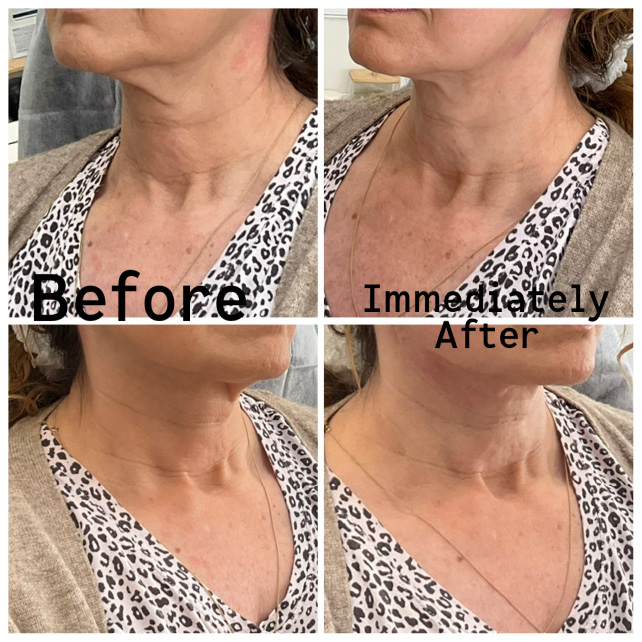
This image shows the appearance before and immediately after PDO lifting thread treatment. Individual results and recovery vary.
A thread lift is only recommended after a consultation, and only if it is the right option for you.
Dr Waxman talks with you about the changes you would like to make, your medical history, any medicines you take and any previous treatments.
She assesses your skin and the degree of sagging, and explains whether threads alone, threads combined with other treatments such as dermal fillers, or a different option would suit you best.
You will hear the potential benefits, risks and side effects in plain terms, along with the costs, before you decide anything.
If you go ahead, you agree a plan together, including the type and number of threads, the areas to treat and your aftercare.
Treatment usually takes 30 to 60 minutes, depending on the areas treated. A local anaesthetic is used to numb the skin, so you should feel little more than pressure. Most people can return to normal daily activities the next day, although you will need to avoid some activities for a few weeks.
With lifting threads, you will see some lift straight away. The full result develops over 6 to 12 weeks as new collagen forms, and results usually last around 12 months or more. For the first few weeks, you will be asked to avoid strenuous exercise, wide mouth opening, facial massage and dental treatment, and to sleep on your back.
Common side effects include swelling, bruising, tenderness and a feeling of tightness. Small dimples or puckering of the skin can appear at first, and these usually settle within a week or two.
Less commonly, a thread can be felt or seen under the skin, move out of place or cause infection, and further treatment may be needed. Threads are generally suited to people aged 30 and over with mild to moderate skin laxity, and they do not give the same result as a surgical facelift. Dr Waxman will review your health history and talk through the risks so you can make an informed decision. If you notice increasing pain, redness or swelling, contact the clinic.
PDO threads are made from polydioxanone (PDO), a biocompatible polymer which undergoes complete hydrolytic degradation. The barbs, molded along the thread, anchor into the superficial dynamic fat pads under the skin, to reposition tissue for a non-surgical lift. This can aid in reducing the signs of ageing.
Dermal Filler, Medical Device Class III to smooth facial wrinkles and folds, correct facial atrophic scars, restore or enhance the lips, or restore facial volume. Dermal filler has risk and benefits. Ask your doctor if dermal filler is right for you. For product information, check with your doctor or from product details with the supplier.
