
At Central CosMedic, Dr Danielle Waxman offers PRP breast lift and décolletage treatment for patients across Havelock North, Hastings, Napier and the wider Hawke’s Bay. Treatment uses platelet-rich plasma (PRP) and non cross-linked hyaluronic acid to improve the skin and fullness of the upper chest and breast, without surgery.
With age, sun exposure and changes such as pregnancy and weight loss, the skin of the chest can become thinner, more lined and less full. This page explains how treatment works, what it can and cannot achieve, and what to expect.
A PRP breast lift uses platelet-rich plasma prepared from a small sample of your own blood. The PRP is injected into the upper part of the breast and the cleavage area, where its growth factors support the skin’s natural repair and help to improve skin quality and fullness.
It is important to know that this is not the same as surgery. A non-surgical breast lift gives a subtle improvement in the shape of the upper breast and the quality of the skin. It does not raise the breasts or change their size in the way a surgical breast lift or augmentation does.
PRP is injected into the upper breast to help round its shape, improve skin texture and soften fine lines.
PRP is injected into the décolletage or upper chest to hydrate the skin and soften lines and creases.
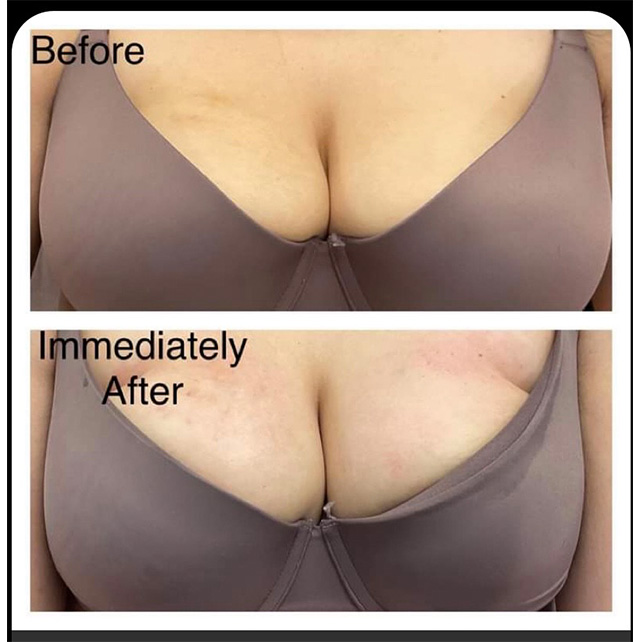
This image shows the appearance before and immediately after Breast Lift treatment. Individual results and recovery vary.
Treatment is only recommended after a consultation, and only if it suits your goals and your health.
Dr Waxman talks with you about what you would like to change, your medical history, any medicines you take and any previous treatments or surgery.
She examines the area and explains what a non-surgical approach can realistically achieve. If surgery is more likely to give you the result you want, she will tell you.
You will hear the potential benefits, risks and side effects in plain terms, along with the costs, before you decide anything.
If you go ahead, you agree a plan together, including which treatments to use and when to review your result.
If PRP is used, a small blood sample is taken at the start of your appointment and prepared while the skin is numbed. Treatment takes around 45 to 60 minutes, and there is little or no downtime.
Some improvement may be seen soon after treatment, and the result continues to develop over the following 12 weeks. Results can last from six months to two years, depending on your skin and lifestyle, and treatment can be repeated.
Common side effects include swelling, bruising, redness and tenderness at the injection sites. These usually settle within a few days. You should wear a supportive bra and avoid strenuous exercise for a short time afterwards, unless Dr Waxman advises otherwise.
Less commonly, treatment can cause infection or small lumps under the skin. Treatment is not suitable during pregnancy or breastfeeding, and you should keep up your usual breast screening, including mammograms, and let the radiographer know you have had treatment. Dr Waxman will review your health history and talk through the risks so you can make an informed decision.
